ADMiRAL
← Back to Dashboard

Data Output / Papers

Latest peer-reviewed research and telemetry analyses.

Show All Archive ➔
Paper Figure
2026 // Astronomy & Astrophysics

RadioAstron reveals a change in the jet collimation profile of 3C 84

Benke P. et al.

Abstract

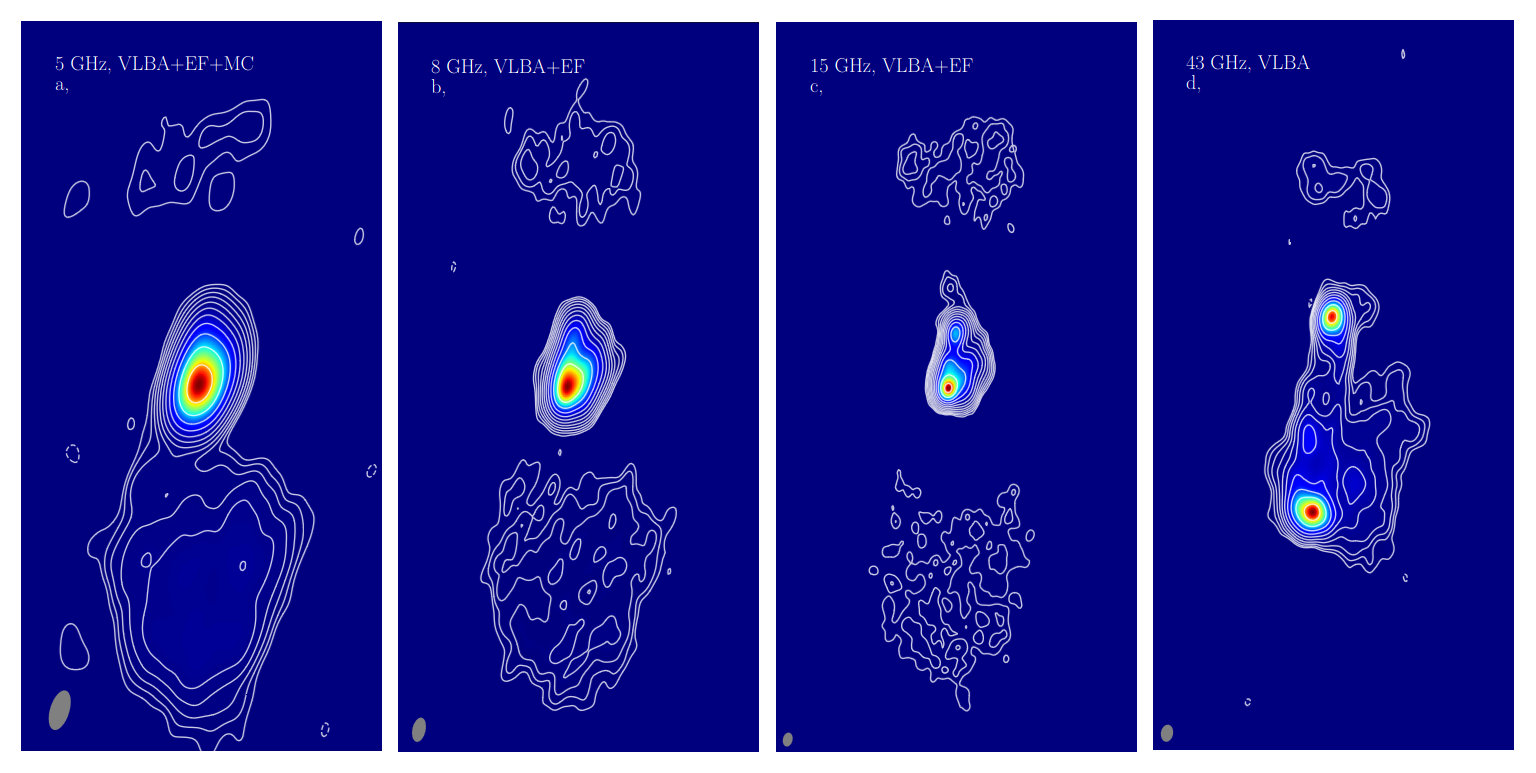
Context. Due to its brightness and proximity, the radio galaxy 3C 84 (optical counterpart NGC 1275 in the Perseus cluster) has been the target of extensive studies investigating the central parsec region of its active galactic nucleus. In 2003, its most recent active phase resulted in a plasma ejection visible in the southern jet, which presented a unique opportunity to study jet formation and evolution at high angular resolution with very long baseline interferometry (VLBI). Aims. We aim to study the morphology, evolution, and spectral properties of the restarted jet three years after the first ultra-high angular resolution observations with the RadioAstron space-VLBI satellite in September 2013. Methods. To study 3C 84, we used space-VLBI observations carried out in September 2016 at 22 GHz with a global VLBI network and the 10 m Spektr-R radio telescope in orbit as well as quasi-simultaneous multifrequency observations at 4.8, 8, 15, and 43 GHz from the Very Long Baseline Array, including the Effelsberg 100 m telescope. Results. We present the 22 GHz RadioAstron image of 3C 84 from 2016, which reveals the source’s central region at a 58 μas effective resolution. During the three years that elapsed between the first and second space-VLBI observations, the source underwent significant morphological changes. We confirm the existence of the limb-brightened jet and counter-jet reported earlier as well as a flip in the position of the hotspot discovered recently via VLBI monitoring at 43 GHz. Based on measuring the collimation profile, we find that it has evolved from being quasi-cylindrical to parabolic. This is most likely the result of the decreased pressure of the mini-cocoon, which was inflated by the jet and contains hot gas that cannot confine the jet efficiently as it propagates further away from the core. Finally, we also constrained the magnetic field strength in the core region and the hotspot.

ADS Record ↗ arXiv ↗
[+] BibTeX
@ARTICLE{2026A&A...709A.226B,
author = {{Benke}, P. and {Savolainen}, T. and {Giovannini}, G. and {Kovalev}, Y.~Y. and {Bruni}, G. and {Lisakov}, M.~M. and {Giroletti}, M. and {Ros}, E.},
title = "{RadioAstron reveals a change in the jet collimation profile of 3C 84}",
journal = {\aap},
keywords = {techniques: high angular resolution, techniques: interferometric, galaxies: active, galaxies: individual: 3C 84, galaxies: jets, radio continuum: galaxies, Astrophysics of Galaxies},
year = 2026,
month = may,
volume = {709},
eid = {A226},
pages = {A226},
doi = {10.1051/0004-6361/202553859},
archivePrefix = {arXiv},
eprint = {2604.06803},
primaryClass = {astro-ph.GA},
adsurl = {https://ui.adsabs.harvard.edu/abs/2026A&A...709A.226B},
adsnote = {Provided by the SAO/NASA Astrophysics Data System}
}
Paper Figure
2026 // Astronomy & Astrophysics

Spectral index evolution of the limb-brightened jet in 3C 84

Debbrecht, L.~C. et al.

Abstract

Relativistic jets launched by active galactic nuclei are fundamental for understanding the physics of accreting supermassive black holes and their immediate environment, but the mechanisms that drive the jet launching remain uncertain. We investigate the sub- parsec jet of 3C 84 using multi-epoch multi-frequency very long baseline interferometry (VLBI) observations with the European VLBI Network and the Very Long Baseline Array at 22 and 43 GHz. We analysed the evolution of the spectral index gradient in the core region to relate the observed structure to physical interpretations and to distinguish between competing jet- launching models. Furthermore, we examined the effect of the ambient medium and magnetic field configuration on the jet morphology and dynamics over time and explored their connection to a coinciding \ensuremath\gamma-ray flare. Our spectral analysis reveals significant changes across three epochs, indicating dynamic activity between filamentary structures on sub-parsec scales, evolving magnetic fields, and a complex interaction with the surrounding medium, all of which shape the innermost jet and might affect its high-energy emission.

ADS Record ↗ arXiv ↗
[+] BibTeX
@ARTICLE{2026A&A...709A.192D,
       author = {{Debbrecht}, L.~C. and {Paraschos}, G.~F. and {Ros}, E. and {Krichbaum}, T.~P. and {Bach}, U. and {Gurwell}, M.~A. and {Hodgson}, J.~A. and {Janssen}, M. and {Kim}, J.-Y. and {Lisakov}, M.~M. and {MacDonald}, N.~R. and {Nair}, D.~G. and {Oh}, J. and {Zensus}, J.~A.},
        title = "{Spectral index evolution of the limb-brightened jet in 3C 84}",
      journal = {\aap},
     keywords = {instrumentation: high angular resolution, instrumentation: interferometers, galaxies: active, galaxies: jets, quasars: individual: 3C 84, High Energy Astrophysical Phenomena, Astrophysics of Galaxies},
         year = 2026,
        month = may,
       volume = {709},
          eid = {A192},
        pages = {A192},
     abstract = "{Relativistic jets launched by active galactic nuclei are fundamental for
        understanding the physics of accreting supermassive black holes
        and their immediate environment, but the mechanisms that drive
        the jet launching remain uncertain. We investigate the sub-
        parsec jet of 3C 84 using multi-epoch multi-frequency very long
        baseline interferometry (VLBI) observations with the European
        VLBI Network and the Very Long Baseline Array at 22 and 43 GHz.
        We analysed the evolution of the spectral index gradient in the
        core region to relate the observed structure to physical
        interpretations and to distinguish between competing jet-
        launching models. Furthermore, we examined the effect of the
        ambient medium and magnetic field configuration on the jet
        morphology and dynamics over time and explored their connection
        to a coinciding {\ensuremath{\gamma}}-ray flare. Our spectral
        analysis reveals significant changes across three epochs,
        indicating dynamic activity between filamentary structures on
        sub-parsec scales, evolving magnetic fields, and a complex
        interaction with the surrounding medium, all of which shape the
        innermost jet and might affect its high-energy emission.}",
          doi = {10.1051/0004-6361/202558540},
archivePrefix = {arXiv},
       eprint = {2604.11875},
 primaryClass = {astro-ph.HE},
       adsurl = {https://ui.adsabs.harvard.edu/abs/2026A&A...709A.192D},
      adsnote = {Provided by the SAO/NASA Astrophysics Data System}
}
Paper Figure
2026 // MNRAS

Heavy interstellar scattering toward the near end of the Galactic bar

Pushkarev A. et al.

Abstract

We present results of a pilot observational wide-field VLBI (very long baseline interferometry) campaign on probing scattering properties of the partly ionized interstellar medium towards the Galactic plane sky region between 28◦ < l < 36◦ and |b| < 1◦. This covers the region where the Galactic bar connects to the spiral arms and where a lot of star formation is currently ongoing. The VLBA (Very Long Baseline Array) observations of the whole region were performed in a special mode with multiple phase centres at Lband (1.4–1.8 GHz) during 2022 April–June, and a year later, complemented by sessions at S band (2.2–2.4 GHz) and C band (4.6–5.0 GHz) partially covering the pilot region. We found compelling evidence that target sources are subject to scattering. The total detection rate in L, S, and C bands is 1.5, 3.4, and 9.2 per cent, respectively, and approximately scales with the square of the observation frequency. The low rate values imply that scattering is strong. Its power is non-uniform across the Galactic plane, and it can be approximated by a Gaussian with a width of about 2◦ peaking at the Galactic mid-plane. One of the brightest sources of the field shows anisotropic scattering, with a λ2 dependence of its observed angular size, along a position angle of 26◦ aligned with the line of constant Galactic latitude. We estimate the turbulence dissipation scale rin ≈ 1500 km towards the source J1833+0015.

ADS Record ↗ arXiv ↗
[+] BibTeX
@ARTICLE{2026MNRAS.548ag655P,
     author = {{Pushkarev}, A.~B. and {Brunthaler}, A. and {Kovalev}, Y.~Y. and {Lisakov}, M.~M. and {Pashchenko}, I.~N. and {Plavin}, A.~V. and {Roy}, N. and {Voitsik}, P.~A. and {Dzib}, S.~A. and {Koryukova}, T.~A. and {Yang}, A.~Y.},
     title = "{Heavy interstellar scattering toward the near end of the Galactic bar}",
     journal = {\mnras},
     keywords = {scattering, galaxies: active, galaxies: ISM, galaxies: jets, quasars: general, Astrophysics of Galaxies},
     year = 2026,
     month = may,
     volume = {548},
     number = {2},
     eid = {stag655},
     pages = {stag655},
     doi = {10.1093/mnras/stag655},
     archivePrefix = {arXiv},
     eprint = {2602.06785},
     primaryClass = {astro-ph.GA},
     adsurl = {https://ui.adsabs.harvard.edu/abs/2026MNRAS.548ag655P},
     adsnote = {Provided by the SAO/NASA Astrophysics Data System}
}
Paper Figure
2026 // Astronomy & Astrophysics

Full-polarization millimeter wavelength variability of Sagittarius A$^*$ during the 2018 EHT campaign

Albentosa-Ruiz, Ezequiel et al.

Abstract

Context. Sagittarius A* (Sgr A$^$), the supermassive black hole at the center of the Milky Way, provides a unique laboratory to study accretion dynamics and plasma processes near the event horizon. Aims. We investigated the variability and polarization properties of Sgr A$^$ using ALMA observations during the 2018 Event Horizon Telescope campaign. Methods. We analyzed high-cadence full-polarization light curves from ALMA at millimeter wavelengths, performed time-series analysis, and investigated the temporal behavior during an X-ray flare observed by Chandra on 2018 April 24. The variability characteristics are compared with expectations from standard accretion flow models. Results. We find low variability in total intensity (\ensuremath\sigma/\ensuremath\mu < 10%), but significantly higher variability in linear and circular polarization (\ensuremath\sim30% and \ensuremath\sim50%, respectively). A time-series analysis reveals red-noise variability, with power spectral densities between \ensuremath-2 and \ensuremath-3 across all Stokes parameters. Polarized intensity shows stable intra-day timescales, while total intensity exhibits more variable timescales, suggesting distinct emission regions, with polarization likely arising from a coherent structure. On April 24, a statistically significant inter-band delay in polarized intensity coincides with a near-simultaneous X-ray and millimeter peak that deviates from the typical delayed flare scenario. This event also features enhanced millimeter variability and coherent polarization loop evolution. The observed simultaneity challenges standard models of transient synchrotron emission with cooling delays, favoring instead a scenario of continuous energy injection in an optically thin region. Conclusions. Our results offer new constraints on the physical mechanisms driving variability in Sgr A$^*$, and provide key observational input for refining theoretical models of accretion and plasma behavior in the vicinity of supermassive black holes.

ADS Record ↗ arXiv ↗
[+] BibTeX
@ARTICLE{2026A&A...708A.179A,
       author = {{Albentosa-Ruiz}, Ezequiel and {Washington}, Jasmin E. and {Marchili}, Nicola and {Mart{\'\i}-Vidal}, Iv{\'a}n and {Goddi}, Ciriaco and {Wielgus}, Maciek and {Mus}, Alejandro and {Ricarte}, Angelo and {Marrone}, Daniel P. and {Salas}, Le{\'o}n D.~S. and {Iwata}, Yuhei and {Carlos}, Douglas F. and {Tetarenko}, Alexandra J. and {Moriyama}, Kotaro and {Dhruv}, Vedant and {Akiyama}, Kazunori and {Alberdi}, Antxon and {Alef}, Walter and {Carlos Algaba}, Juan and {Anantua}, Richard and {Asada}, Keiichi and {Azulay}, Rebecca and {Bach}, Uwe and {Baczko}, Anne-Kathrin and {Ball}, David and {Balokovi{\'c}}, Mislav and {Bandyopadhyay}, Bidisha and {Barrett}, John and {Baub{\"o}ck}, Michi and {Benson}, Bradford A. and {Bintley}, Dan and {Blackburn}, Lindy and {Blundell}, Raymond and {Bouman}, Katherine L. and {Bower}, Geoffrey C. and {Bremer}, Michael and {Brissenden}, Roger and {Britzen}, Silke and {Broderick}, Avery E. and {Broguiere}, Dominique and {Bronzwaer}, Thomas and {Bustamante}, Sandra and {Carlstrom}, John E. and {Chael}, Andrew and {Chan}, Chi-kwan and {Chang}, Dominic O. and {Chatterjee}, Koushik and {Chatterjee}, Shami and {Chen}, Ming-Tang and {Chen}, Yongjun and {Cheng}, Xiaopeng and {Christian}, Pierre and {Cho}, Ilje and {Conroy}, Nicholas S. and {Conway}, John E. and {Crawford}, Thomas M. and {Crew}, Geoffrey B. and {Cruz-Osorio}, Alejandro and {Cui}, Yuzhu and {Curd}, Brandon and {Dahale}, Rohan and {Davelaar}, Jordy and {De Laurentis}, Mariafelicia and {Deane}, Roger and {Dempsey}, Jessica and {Desvignes}, Gregory and {Dexter}, Jason and {Dihingia}, Indu K. and {Doeleman}, Sheperd S. and {Dzib}, Sergio A. and {Eatough}, Ralph P. and {Emami}, Razieh and {Falcke}, Heino and {Farah}, Joseph and {Fish}, Vincent L. and {Fomalont}, Edward and {Alyson Ford}, H. and {Foschi}, Marianna and {Fuentes}, Antonio and {Fraga-Encinas}, Raquel and {Freeman}, William T. and {Friberg}, Per and {Fromm}, Christian M. and {Galison}, Peter and {Gammie}, Charles F. and {Garc{\'\i}a}, Roberto and {Gentaz}, Olivier and {Geertsema}, Gertie and {Georgiev}, Boris and {Gold}, Roman and {G{\'o}mez}, Jos{\'e} L. and {G{\'o}mez-Ruiz}, Arturo I. and {Gu}, Minfeng and {Gurwell}, Mark and {Hada}, Kazuhiro and {Haggard}, Daryl and {Hesper}, Ronald and {Heumann}, Dirk and {Ho}, Luis C. and {Ho}, Paul and {Honma}, Mareki and {Huang}, Chih-Wei L. and {Huang}, Lei and {Hughes}, David H. and {Ikeda}, Shiro and {Violette Impellizzeri}, C.~M. and {Inoue}, Makoto and {Issaoun}, Sara and {James}, David J. and {Jannuzi}, Buell T. and {Janssen}, Michael and {Jeter}, Britton and {Jiang}, Wu and {Jim{\'e}nez-Rosales}, Alejandra and {Johnson}, Michael D. and {Jones}, Adam C. and {Jorstad}, Svetlana and {Joshi}, Abhishek V. and {Jung}, Taehyun and {Karuppusamy}, Ramesh and {Kawashima}, Tomohisa and {Keating}, Garrett K. and {Kettenis}, Mark and {Kim}, Dong-Jin and {Kim}, Jae-Young and {Kim}, Jongsoo and {Kim}, Junhan and {Kino}, Motoki and {Yi Koay}, Jun and {Kocherlakota}, Prashant and {Kofuji}, Yutaro and {Koch}, Patrick M. and {Koyama}, Shoko and {Kramer}, Carsten and {Kramer}, Joana A. and {Kramer}, Michael and {Krichbaum}, Thomas P. and {Kuo}, Cheng-Yu and {La Bella}, Noemi and {Lee}, Sang-Sung and {Levis}, Aviad and {Li}, Zhiyuan and {Lico}, Rocco and {Lindahl}, Greg and {Lindqvist}, Michael and {Lisakov}, Mikhail and {Liu}, Jun and {Liu}, Kuo and {Liuzzo}, Elisabetta and {Lo}, Wen-Ping and {Lobanov}, Andrei P. and {Loinard}, Laurent and {Lonsdale}, Colin J. and {Lowitz}, Amy E. and {Lu}, Ru-Sen and {MacDonald}, Nicholas R. and {Mao}, Jirong and {Markoff}, Sera and {Marscher}, Alan P. and {Matsushita}, Satoki and {Matthews}, Lynn D. and {Medeiros}, Lia and {Menten}, Karl M. and {Mizuno}, Izumi and {Mizuno}, Yosuke and {Montgomery}, Joshua and {Moran}, James M. and {Moscibrodzka}, Monika and {Mulaudzi}, Wanga and {M{\"u}ller}, Hendrik and {M{\"u}ller}, Cornelia and {Musoke}, Gibwa and {Myserlis}, Ioannis and {Nagai}, Hiroshi and {Nagar}, Neil M. and {Nair}, Dhanya G. and {Nakamura}, Masanori and {Narayanan}, Gopal and {Natarajan}, Iniyan and {Nathanail}, Antonios and {Navarro Fuentes}, Santiago and {Neilsen}, Joey and {Ni}, Chunchong and {Nowak}, Michael A. and {Oh}, Junghwan and {Okino}, Hiroki and {Olivares S{\'a}nchez}, H{\'e}ctor Ra{\'u}l and {Oyama}, Tomoaki and {{\"O}zel}, Feryal and {Palumbo}, Daniel C.~M. and {Paraschos}, Georgios Filippos and {Park}, Jongho and {Parsons}, Harriet and {Patel}, Nimesh and {Pen}, Ue-Li and {Pesce}, Dominic W. and {Pi{\'e}tu}, Vincent and {PopStefanija}, Aleksandar and {Porth}, Oliver and {Prather}, Ben},
        title = "{Full-polarization millimeter wavelength variability of Sagittarius A$^{*}$ during the 2018 EHT campaign}",
      journal = {\aap},
     keywords = {black hole physics, techniques: interferometric, techniques: polarimetric, Galaxy: center, Astrophysics of Galaxies, High Energy Astrophysical Phenomena},
         year = 2026,
        month = apr,
       volume = {708},
          eid = {A179},
        pages = {A179},
     abstract = "{Context. Sagittarius A* (Sgr A$^{*}$), the supermassive black hole at
        the center of the Milky Way, provides a unique laboratory to
        study accretion dynamics and plasma processes near the event
        horizon. Aims. We investigated the variability and polarization
        properties of Sgr A$^{*}$ using ALMA observations during the
        2018 Event Horizon Telescope campaign. Methods. We analyzed
        high-cadence full-polarization light curves from ALMA at
        millimeter wavelengths, performed time-series analysis, and
        investigated the temporal behavior during an X-ray flare
        observed by Chandra on 2018 April 24. The variability
        characteristics are compared with expectations from standard
        accretion flow models. Results. We find low variability in total
        intensity ({\ensuremath{\sigma}}/{\ensuremath{\mu}} < 10\%), but
        significantly higher variability in linear and circular
        polarization ({\ensuremath{\sim}}30\% and
        {\ensuremath{\sim}}50\%, respectively). A time-series analysis
        reveals red-noise variability, with power spectral densities
        between {\ensuremath{-}}2 and {\ensuremath{-}}3 across all
        Stokes parameters. Polarized intensity shows stable intra-day
        timescales, while total intensity exhibits more variable
        timescales, suggesting distinct emission regions, with
        polarization likely arising from a coherent structure. On April
        24, a statistically significant inter-band delay in polarized
        intensity coincides with a near-simultaneous X-ray and
        millimeter peak that deviates from the typical delayed flare
        scenario. This event also features enhanced millimeter
        variability and coherent polarization loop evolution. The
        observed simultaneity challenges standard models of transient
        synchrotron emission with cooling delays, favoring instead a
        scenario of continuous energy injection in an optically thin
        region. Conclusions. Our results offer new constraints on the
        physical mechanisms driving variability in Sgr A$^{*}$, and
        provide key observational input for refining theoretical models
        of accretion and plasma behavior in the vicinity of supermassive
        black holes.}",
          doi = {10.1051/0004-6361/202556759},
archivePrefix = {arXiv},
       eprint = {2604.10287},
 primaryClass = {astro-ph.GA},
       adsurl = {https://ui.adsabs.harvard.edu/abs/2026A&A...708A.179A},
      adsnote = {Provided by the SAO/NASA Astrophysics Data System}
}
Paper Figure
2026 // The Astrophysical Journal

Ring Asymmetry and Spin in M87*

Bernshteyn, Vadim et al.

Abstract

Event Horizon Telescope (EHT) images of the supermassive black hole M87* depict an asymmetric ring of emission. General relativistic magnetohydrodynamic (GRMHD) models of M87* and its accretion disk predict that the amplitude and location of the ring’s peak brightness asymmetry should fluctuate due to turbulence in the source plasma. We compare the observed distribution of brightness asymmetry amplitudes to the simulated distribution in GRMHD models, across varying black hole spin a$*$. We show that, for strongly magnetized (MAD) models, three epochs of EHT data marginally disfavor \ensuremath\mida$$\ensuremath\mid \ensuremath\lesssim 0.2. This is consistent with the Blandford─Znajek model for M87’s jet, which predicts that M87 should have nonzero spin. We show quantitatively how future observations could improve spin constraints and discuss how improved spin constraints could distinguish between differing jet-launching mechanisms and black hole growth scenarios.

ADS Record ↗ arXiv ↗
[+] BibTeX
@ARTICLE{2026ApJ..1000..231B,
       author = {{Bernshteyn}, Vadim and {Conroy}, Nicholas S. and {Baub{\"o}ck}, Michi and {Tiede}, Paul and {Joshi}, Abhishek V. and {Prather}, Ben S. and {Gammie}, Charles F. and {The Event Horizon Telescope Collaboration} and {Akiyama}, Kazunori and {Albentosa-Ru{\'\i}z}, Ezequiel and {Alberdi}, Antxon and {Alef}, Walter and {Algaba}, Juan Carlos and {Anantua}, Richard and {Asada}, Keiichi and {Azulay}, Rebecca and {Baczko}, Anne-Kathrin and {Ball}, David and {Bandyopadhyay}, Bidisha and {Barrett}, John and {Benson}, Bradford A. and {Bintley}, Dan and {Blackburn}, Lindy and {Blundell}, Raymond and {Bouman}, Katherine L. and {Bower}, Geoffrey C. and {Bremer}, Michael and {Brissenden}, Roger and {Britzen}, Silke and {Broderick}, Avery E. and {Broguiere}, Dominique and {Bronzwaer}, Thomas and {Bustamante}, Sandra and {Carlos}, Douglas F. and {Carlstrom}, John E. and {Chael}, Andrew and {Chan}, Chi-kwan and {Chang}, Dominic O. and {Chatterjee}, Koushik and {Chen}, Ming-Tang and {Chen}, Yongjun and {Cheng}, Xiaopeng and {Chichura}, Paul and {Cho}, Ilje and {Conway}, John E. and {Crawford}, Thomas M. and {Crew}, Geoffrey B. and {Cruz-Osorio}, Alejandro and {Cui}, Yuzhu and {Curd}, Brandon and {Dahale}, Rohan and {Davelaar}, Jordy and {De Laurentis}, Mariafelicia and {Deane}, Roger and {Dexter}, Jason and {Dhruv}, Vedant and {Dihingia}, Indu K. and {Doeleman}, Sheperd S. and {Dzib}, Sergio A. and {Emami}, Razieh and {Falcke}, Heino and {Farah}, Joseph and {Fish}, Vincent L. and {Fomalont}, Edward and {Ford}, H. Alyson and {Foschi}, Marianna and {Fraga-Encinas}, Raquel and {Freeman}, William T. and {Friberg}, Per and {Fromm}, Christian M. and {Fuentes}, Antonio and {Galison}, Peter and {Garc{\'\i}a}, Roberto and {Gentaz}, Olivier and {Georgiev}, Boris and {Goddi}, Ciriaco and {Gold}, Roman and {G{\'o}mez-Ruiz}, Arturo I. and {G{\'o}mez}, Jos{\'e} L. and {Gu}, Minfeng and {Gurwell}, Mark and {Hada}, Kazuhiro and {Haggard}, Daryl and {Hesper}, Ronald and {Heumann}, Dirk and {Ho}, Luis C. and {Ho}, Paul and {Honma}, Mareki and {Huang}, Chih-Wei L. and {Huang}, Lei and {Hughes}, David H. and {Ikeda}, Shiro and {Impellizzeri}, C.~M. Violette and {Inoue}, Makoto and {Issaoun}, Sara and {James}, David J. and {Jannuzi}, Buell T. and {Janssen}, Michael and {Jeter}, Britton and {Jiang}, Wu and {Jim{\'e}nez-Rosales}, Alejandra and {Johnson}, Michael D. and {Jorstad}, Svetlana and {Jones}, Adam C. and {Jung}, Taehyun and {Kawashima}, Tomohisa and {Keating}, Garrett K. and {Kettenis}, Mark and {Kim}, Dong-Jin and {Kim}, Jae-Young and {Kim}, Jongsoo and {Kim}, Junhan and {Kino}, Motoki and {Koay}, Jun Yi and {Kocherlakota}, Prashant and {Kofuji}, Yutaro and {Koch}, Patrick M. and {Koyama}, Shoko and {Kramer}, Carsten and {Kramer}, Joana A. and {Kramer}, Michael and {Krichbaum}, Thomas P. and {Kuo}, Cheng-Yu and {La Bella}, Noemi and {Lee}, Deokhyeong and {Lee}, Sang-Sung and {Levis}, Aviad and {Li}, Shaoliang and {Li}, Zhiyuan and {Lico}, Rocco and {Lindahl}, Greg and {Lindqvist}, Michael and {Lisakov}, Mikhail and {Liu}, Jun and {Liu}, Kuo and {Liuzzo}, Elisabetta and {Lo}, Wen-Ping and {Lobanov}, Andrei P. and {Loinard}, Laurent and {Lonsdale}, Colin J. and {Lowitz}, Amy E. and {Lu}, Ru-Sen and {MacDonald}, Nicholas R. and {Mao}, Jirong and {Marchili}, Nicola and {Markoff}, Sera and {Marrone}, Daniel P. and {Marscher}, Alan P. and {Mart{\'\i}-Vidal}, Iv{\'a}n and {Matsushita}, Satoki and {Matthews}, Lynn D. and {Medeiros}, Lia and {Menten}, Karl M. and {Messias}, Hugo and {Mizuno}, Izumi and {Mizuno}, Yosuke and {Montgomery}, Joshua and {Moriyama}, Kotaro and {Moscibrodzka}, Monika and {Mulaudzi}, Wanga and {M{\"u}ller}, Cornelia and {M{\"u}ller}, Hendrik and {Mus}, Alejandro and {Musoke}, Gibwa and {Myserlis}, Ioannis and {Nagai}, Hiroshi and {Nagar}, Neil M. and {Nair}, Dhanya G. and {Nakamura}, Masanori and {Narayanan}, Gopal and {Natarajan}, Iniyan and {Nathanail}, Antonios and {Navarro Fuentes}, Santiago and {Neilsen}, Joey and {Ni}, Chunchong and {Nowak}, Michael A. and {Okino}, Hiroki and {Olivares S{\'a}nchez}, H{\'e}ctor Ra{\'u}l and {{\"O}zel}, Feryal and {Palumbo}, Daniel C.~M. and {Paraschos}, Georgios Filippos and {Park}, Jongho and {Parsons}, Harriet and {Patel}, Nimesh and {Pen}, Ue-Li and {Pesce}, Dominic W. and {Pi{\'e}tu}, Vincent and {Plavin}, Alexander and {PopStefanija}, Aleksandar and {Porth}, Oliver and {Principe}, Giacomo and {Psaltis}, Dimitrios and {Pu}, Hung-Yi and {Rahlin}, Alexandra and {Ramakrishnan}, Venkatessh and {Rao}, Ramprasad and {Rawlings}, Mark G. and {Rezzolla}, Luciano and {Ricarte}, Angelo and {Ricci}, Luca},
        title = "{Ring Asymmetry and Spin in M87*}",
      journal = {\apj},
     keywords = {Supermassive black holes, Accretion, Low-luminosity active galactic nuclei, Magnetohydrodynamics, Radiative transfer, Very long baseline interferometry, 1663, 14, 2033, 1964, 1335, 1769, High Energy Astrophysical Phenomena},
         year = 2026,
        month = apr,
       volume = {1000},
       number = {2},
          eid = {231},
        pages = {231},
     abstract = "{Event Horizon Telescope (EHT) images of the supermassive black hole M87*
        depict an asymmetric ring of emission. General relativistic
        magnetohydrodynamic (GRMHD) models of M87* and its accretion
        disk predict that the amplitude and location of the ring's peak
        brightness asymmetry should fluctuate due to turbulence in the
        source plasma. We compare the observed distribution of
        brightness asymmetry amplitudes to the simulated distribution in
        GRMHD models, across varying black hole spin a$_{*}$. We show
        that, for strongly magnetized (MAD) models, three epochs of EHT
        data marginally disfavor
        {\ensuremath{\mid}}a$_{*}${\ensuremath{\mid}}
        {\ensuremath{\lesssim}} 0.2. This is consistent with the
        Blandford─Znajek model for M87's jet, which predicts that M87*
        should have nonzero spin. We show quantitatively how future
        observations could improve spin constraints and discuss how
        improved spin constraints could distinguish between differing
        jet-launching mechanisms and black hole growth scenarios.}",
          doi = {10.3847/1538-4357/ae34af},
archivePrefix = {arXiv},
       eprint = {2601.00394},
 primaryClass = {astro-ph.HE},
       adsurl = {https://ui.adsabs.harvard.edu/abs/2026ApJ..1000..231B},
      adsnote = {Provided by the SAO/NASA Astrophysics Data System}
}
Paper Figure
2026 // Astronomy & Astrophysics

Locating the missing large-scale emission in the jet of M87* with short EHT baselines

Georgiev, Boris et al.

Abstract

In very-long baseline interferometric arrays, nearly co-located stations probe the largest scales and typically cannot resolve the observed source. In the absence of a large-scale structure, closure phases constructed with these stations are zero and, since they are independent of station-based errors, they can be used to probe data issues. Here, we show how these trivial closure phases become nonzero with a brightness distribution on smaller scales than their short baseline would suggest. When applied to sources that are made up of a bright compact and large-scale diffuse component, the trivial closure phases directly measure the centroid relative to the compact source and higher-order image moments. We present a technique to measure these image moments with minimal model assumptions and validate it on synthetic Event Horizon Telescope (EHT) data. We then apply this technique to 2017 and 2018 EHT observations of M87$^*$ and find a weak preference for extended emission in the direction of the large-scale jet. We also apply it to 2021 EHT data and measure the source centroid about 1 mas northwest of the compact ring, which is consistent with the jet observed at lower frequencies.

ADS Record ↗ arXiv ↗
[+] BibTeX
@ARTICLE{2026A&A...709A..26G,
       author = {{Georgiev}, Boris and {Tiede}, Paul and {von Fellenberg}, Sebastiano D. and {Janssen}, Michael and {Natarajan}, Iniyan and {Blackburn}, Lindy and {Park}, Jongho and {Chavez}, Erandi and {West}, Andrew T. and {Moriyama}, Kotaro and {Koay}, Jun Yi and {M{\"u}ller}, Hendrik and {Nair}, Dhanya G. and {Broderick}, Avery E. and {Wielgus}, Maciek and {The Event Horizon Telescope Collaboration} and {Akiyama}, Kazunori and {Albentosa-Ru{\'\i}z}, Ezequiel and {Alberdi}, Antxon and {Alef}, Walter and {Algaba}, Juan Carlos and {Anantua}, Richard and {Asada}, Keiichi and {Azulay}, Rebecca and {Bach}, Uwe and {Baczko}, Anne-Kathrin and {Ball}, David and {Balokovi{\'c}}, Mislav and {Bandyopadhyay}, Bidisha and {Barrett}, John and {Baub{\"o}ck}, Michi and {Benson}, Bradford A. and {Bintley}, Dan and {Blundell}, Raymond and {Bouman}, Katherine L. and {Bower}, Geoffrey C. and {Bremer}, Michael and {Brissenden}, Roger and {Britzen}, Silke and {Broguiere}, Dominique and {Bronzwaer}, Thomas and {Bustamante}, Sandra and {Carlos}, Douglas F. and {Carlstrom}, John E. and {Chael}, Andrew and {Chan}, Chi-kwan and {Chang}, Dominic O. and {Chatterjee}, Koushik and {Chatterjee}, Shami and {Chen}, Ming-Tang and {Chen}, Yongjun and {Cheng}, Xiaopeng and {Chichura}, Paul and {Cho}, Ilje and {Christian}, Pierre and {Conroy}, Nicholas S. and {Conway}, John E. and {Crawford}, Thomas M. and {Crew}, Geoffrey B. and {Cruz-Osorio}, Alejandro and {Cui}, Yuzhu and {Curd}, Brandon and {Dahale}, Rohan and {Davelaar}, Jordy and {De Laurentis}, Mariafelicia and {Deane}, Roger and {Desvignes}, Gregory and {Dexter}, Jason and {Dhruv}, Vedant and {Dihingia}, Indu K. and {Doeleman}, Sheperd S. and {Dzib}, Sergio A. and {Eatough}, Ralph P. and {Emami}, Razieh and {Falcke}, Heino and {Farah}, Joseph and {Fish}, Vincent L. and {Fomalont}, Edward and {Alyson Ford}, H. and {Foschi}, Marianna and {Fraga-Encinas}, Raquel and {Freeman}, William T. and {Friberg}, Per and {Fromm}, Christian M. and {Fuentes}, Antonio and {Galison}, Peter and {Gammie}, Charles F. and {Garc{\'\i}a}, Roberto and {Gentaz}, Olivier and {Goddi}, Ciriaco and {Gold}, Roman and {G{\'o}mez-Ruiz}, Arturo I. and {G{\'o}mez}, Jos{\'e} L. and {Gu}, Minfeng and {Gurwell}, Mark and {Hada}, Kazuhiro and {Haggard}, Daryl and {Hesper}, Ronald and {Heumann}, Dirk and {Ho}, Luis C. and {Ho}, Paul and {Honma}, Mareki and {Huang}, Chih-Wei L. and {Huang}, Lei and {Hughes}, David H. and {Ikeda}, Shiro and {Violette Impellizzeri}, C.~M. and {Inoue}, Makoto and {Issaoun}, Sara and {James}, David J. and {Jannuzi}, Buell T. and {Jeter}, Britton and {Jiang}, Wu and {Jim{\'e}nez-Rosales}, Alejandra and {Johnson}, Michael D. and {Jorstad}, Svetlana and {Jones}, Adam C. and {Joshi}, Abhishek V. and {Jung}, Taehyun and {Karuppusamy}, Ramesh and {Kawashima}, Tomohisa and {Keating}, Garrett K. and {Kettenis}, Mark and {Kim}, Dong-Jin and {Kim}, Jae-Young and {Kim}, Jongsoo and {Kim}, Junhan and {Kino}, Motoki and {Kocherlakota}, Prashant and {Kofuji}, Yutaro and {Koch}, Patrick M. and {Koyama}, Shoko and {Kramer}, Carsten and {Kramer}, Joana A. and {Kramer}, Michael and {Krichbaum}, Thomas P. and {Kuo}, Cheng-Yu and {La Bella}, Noemi and {Lee}, Deokhyeong and {Lee}, Sang-Sung and {Levis}, Aviad and {Li}, Zhiyuan and {Lico}, Rocco and {Lindahl}, Greg and {Lindqvist}, Michael and {Lisakov}, Mikhail and {Liu}, Jun and {Liu}, Kuo and {Liuzzo}, Elisabetta and {Lo}, Wen-Ping and {Lobanov}, Andrei P. and {Loinard}, Laurent and {Lonsdale}, Colin J. and {Lowitz}, Amy E. and {Lu}, Ru-Sen and {MacDonald}, Nicholas R. and {Mao}, Jirong and {Marchili}, Nicola and {Markoff}, Sera and {Marrone}, Daniel P. and {Marscher}, Alan P. and {Mart{\'\i}-Vidal}, Iv{\'a}n and {Matsushita}, Satoki and {Matthews}, Lynn D. and {Medeiros}, Lia and {Menten}, Karl M. and {Mizuno}, Izumi and {Mizuno}, Yosuke and {Montgomery}, Joshua and {Moran}, James M. and {Moscibrodzka}, Monika and {Mulaudzi}, Wanga and {M{\"u}ller}, Cornelia and {Mus}, Alejandro and {Musoke}, Gibwa and {Myserlis}, Ioannis and {Nagai}, Hiroshi and {Nagar}, Neil M. and {Nakamura}, Masanori and {Narayanan}, Gopal and {Nathanail}, Antonios and {Navarro Fuentes}, Santiago and {Neilsen}, Joey and {Ni}, Chunchong and {Nowak}, Michael A. and {Oh}, Junghwan and {Okino}, Hiroki and {Olivares S{\'a}nchez}, H{\'e}ctor Ra{\'u}l and {Oyama}, Tomoaki and {{\"O}zel}, Feryal and {Palumbo}, Daniel C.~M. and {Paraschos}, Georgios Filippos and {Parsons}, Harriet and {Patel}, Nimesh and {Pen}, Ue-Li and {Pesce}, Dominic W. and {Pi{\'e}tu}, Vincent and {Plavin}, Alexander and {PopStefanija}, Aleksandar and {Porth}, Oliver},
        title = "{Locating the missing large-scale emission in the jet of M87* with short EHT baselines}",
      journal = {\aap},
     keywords = {black hole physics, techniques: interferometric, galaxies: active, galaxies: individual: M87*, galaxies: jets, High Energy Astrophysical Phenomena, Instrumentation and Methods for Astrophysics},
         year = 2026,
        month = apr,
       volume = {709},
          eid = {A26},
        pages = {A26},
     abstract = "{In very-long baseline interferometric arrays, nearly co-located stations
        probe the largest scales and typically cannot resolve the
        observed source. In the absence of a large-scale structure,
        closure phases constructed with these stations are zero and,
        since they are independent of station-based errors, they can be
        used to probe data issues. Here, we show how these trivial
        closure phases become nonzero with a brightness distribution on
        smaller scales than their short baseline would suggest. When
        applied to sources that are made up of a bright compact and
        large-scale diffuse component, the trivial closure phases
        directly measure the centroid relative to the compact source and
        higher-order image moments. We present a technique to measure
        these image moments with minimal model assumptions and validate
        it on synthetic Event Horizon Telescope (EHT) data. We then
        apply this technique to 2017 and 2018 EHT observations of
        M87$^{*}$ and find a weak preference for extended emission in
        the direction of the large-scale jet. We also apply it to 2021
        EHT data and measure the source centroid about 1 mas northwest
        of the compact ring, which is consistent with the jet observed
        at lower frequencies.}",
          doi = {10.1051/0004-6361/202557013},
archivePrefix = {arXiv},
       eprint = {2601.13356},
 primaryClass = {astro-ph.HE},
       adsurl = {https://ui.adsabs.harvard.edu/abs/2026A&A...709A..26G},
      adsnote = {Provided by the SAO/NASA Astrophysics Data System}
}
Paper Figure
2025 // Astronomy & Astrophysics

Kilogauss magnetic field and jet dynamics in the quasar NRAO 530

Mikhail Lisakov et al.

Abstract

Context. The advancement of the Event Horizon Telescope has enabled the study of relativistic jets in active galactic nuclei down to sub-parsec linear scales even at high redshift. Quasi-simultaneous multifrequency observations provide insights into the physical conditions in compact regions and allow accretion theories to be tested. Aims. Initially, we aimed to measure the magnetic field strength close to the central supermassive black hole in NRAO 530 (1730−130) by studying the frequency-dependent opacity of the jet matter, Faraday rotation, and the spectral index in the millimeter-radio bands. Methods. NRAO 530 was observed quasi-simultaneously at 15, 22, 43, 86, and 227 GHz at four different very long baseline interferometer (VLBI) networks. By means of imaging and model-fitting, we aligned the images, taken at different frequencies. We explored opacity along the jet and the distribution of the linearly polarized emission in it. Results. Our findings reveal that the jet of NRAO 530 at 86 and 227 GHz is transparent down to its origin, with 70 mJy emission detected at 227 GHz potentially originating from the accretion disk. The magnetic field strength near the black hole, estimated at 5rg, is 3 × 10³−3 × 10⁴ G (depending on the central black hole mass). These values represent some of the highest magnetic field strengths reported for active galaxies. We also report the first ever VLBI measurement of the Faraday rotation at 43−227 GHz, which reveals rotation measure values as high as −48 000 rad/m2, consistent with higher particle density and stronger magnetic fields at the jet’s outset. The complex shape of the jet in NRAO 530 is in line with the expected behavior of a precessing jet, with a period estimated to be around 6 ± 4 years.

ADS Record ↗ arXiv ↗
[+] BibTeX
@ARTICLE{2025A&A...693A...9L,
       author = {{Lisakov}, Mikhail and {Jorstad}, Svetlana and {Wielgus}, Maciek and {Kravchenko}, Evgeniya V. and {Nikonov}, Aleksei S. and {Cho}, Ilje and {Issaoun}, Sara and {Algaba}, Juan-Carlos and {Krichbaum}, Thomas P. and {Bach}, Uwe and {Ros}, Eduardo and {Rottmann}, Helge and {S{\\'a}nchez}, Salvador and {Wagner}, Jan and {Zensus}, Anton},
        title = "{Kilogauss magnetic field and jet dynamics in the quasar NRAO 530}",
      journal = {\aap},
     keywords = {accretion, accretion disks, techniques: interferometric, galaxies: jets, galaxies: magnetic fields, quasars: supermassive black holes, quasars: individual: NRAO 530, Astrophysics - Astrophysics of Galaxies, Astrophysics - High Energy Astrophysical Phenomena},
         year = 2025,
        month = jan,
       volume = {693},
          eid = {A9},
        pages = {A9},
          doi = {10.1051/0004-6361/202449636},
archivePrefix = {arXiv},
       eprint = {2411.03446},
 primaryClass = {astro-ph.GA},
       adsurl = {https://ui.adsabs.harvard.edu/abs/2025A&A...693A...9L},
      adsnote = {Provided by the SAO/NASA Astrophysics Data System}
}